
Showing posts with label Saints. Show all posts
Showing posts with label Saints. Show all posts
Wednesday, April 25, 2012
A Message for Us All

Monday, April 16, 2012
The Feast of St. Bernadette
 |
| St. Bernadette died on this day in the year 1879. Let us celebrate her life and recall the message of Our Lady of Lourdes! |
Friday, March 23, 2012
St. Toribio Alfonso de Mogrovejo
Read the below article from Catholic Online:
 Bishop and defender of the rights of the native Indians in Peru, Born in Mayorga, Spain, he studied law and became a lawyer and then professor at Salamanca, receiving appointment-despite being a layman-as chief judge of the court of Inquisition at Granada under King Philip II of Spain. The king subsequently appointed him in 1580 to the post of archbishop of Lima, Peru. After receiving ordination and then consecration, he arrived in Peru in 1581 and soon demonstrated a deep zeal to reform the archdiocese and a determination to do all in his power to aid the poor and defend the rights of the Indians who were then suffering severely under Spanish occupation. He founded schools, churches, hospitals, and the first seminary in the New World. To assist his pastoral work among the Indians, he also mastered several Indian dialects. He was canonized in 1726.
Visit Catholic Online to read his complete biography!
Visit Catholic Online to read his complete biography!
Wednesday, February 15, 2012
Saint Walfrid, February 15th
The following is taken from Catholic Online and is slightly edited. Visit the website to learn more about St. Walfrid and many other saints!
Walfrid or Galfrido della Gherardesca was born in Pisa, of which he became a prosperous and honored citizen. He married a wife to whom he was deeply attached, and they had five sons and at least one daughter. After a time, Walfrid and his wife Thesia felt that God was calling them to enter the religious life. Walfrid had two friends - A kinsman named Gunduald and a certain Fortis, a native of Corsica: like him they were living in the world, but were drawn to a closer service of God under monastic discipline. Together they discussed the future, and were led by a dream to choose Monte Verde, between Volterra and Piombino, as the site of their future monastery. They decided to follow the Benedictine Rule of Monte Casino and, besides their own Abbey of Palazzuolo, they built at a distance of about eighteen miles a convent for women, in which their wives and Walfrid's daughter Rattruda took the veil. The new foundation attracted many novices, and before long there were sixty monks including Walfrid's favorite son Gimfrid and Gunduald's only son Andrew, who became the third Abbott and wrote the history of St. Walfrid. Walfrid ruled the Abbey wisely and well for ten years, and after his death, was succeeded by Gimfrid, who, as Andrew records, was a great and good pastor. St. Walfrid's cultus was confirmed in 1861. His feast day is February 15th.
Saturday, January 14, 2012
Today's Saint - Felix of Nola
Felix was the son of Hermias, a Syrian who had been a Roman soldier. He was born on his father's estate at Nola near Naples, Italy. On the death of his father, Felix distributed his inheritance to the poor, was ordained by Bishop St. Maximus of Nola, and became his assistant... Read More
Saturday, January 7, 2012
Today's Saint Jan. 7th
Friday, January 6, 2012
Today's Saint
On January 6th we celebrate the feast of St. Andre Bessette. Learn about his witness to the Faith at Catholic Online.
Tuesday, December 6, 2011
St. Nicholas' Day!
How many of you woke up this morning with candy in your shoes? Happy St. Nicholas' Day!
Here is a prayer to St. Nicholas:
Here is a prayer to St. Nicholas:
O good holy Nicholas,
you who brought joy to children,
put in my heart the spirit of childhood
about which the Gospel speaks.
Teach me how to sow
happiness around me. Amen
you who brought joy to children,
put in my heart the spirit of childhood
about which the Gospel speaks.
Teach me how to sow
happiness around me. Amen
(Prayer from http://www.stnicholascenter.org/pages/prayers-for-children/ originally from Catholic Greetings)
 |
| (From The St. Nicholas Center http://www.stnicholascenter.org/pages/media-images/) Visit the St. Nicholas Center to learn more about St. Nicholas! |
Tuesday, November 22, 2011

Friday, November 4, 2011
The Feast of St. Charles Borromeo
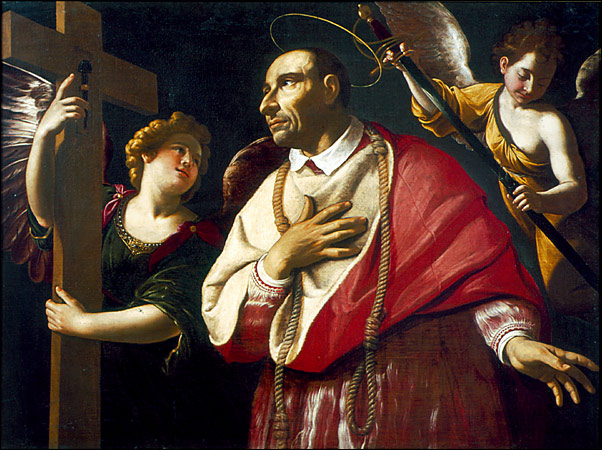
Vatican City, Nov 4, 2009 / 11:37 am (CNA).- Concluding today’s weekly audience, Pope Benedict noted that today's feast day celebrates the life of St. Charles Borromeo, “an outstanding bishop of the diocese of Milan who, animated by ardent love for Christ, was a tireless master and guide to his brothers and sisters.”
St. Charles Borromeo, the son of a wealthy family in Italy, was instrumental in the reconvention of the Council of Trent, as well as in the creation of the decrees issued by the council. Born in 1538, St. Charles later became a priest and was appointed Bishop of Milan by his uncle, Pope Pius IV. However, before being sent to Milan, he initiated several reforms in the Diocese of Trent, which had been without a resident bishop for 80 years. Under his influence, Trent became a model diocese.
While Bishop of Milan, St. Charles oversaw many reforms of the clergy, the liturgy and of religious education. While he encountered much opposition, he was very active in preaching and ministry, and was famous for bringing back many lapsed Catholics to the Church.
Though he was a member of the wealthy and powerful Medici family, St. Charles did everything with humility and unselfishness, choosing not to rely on corruption to influence others. He gave Church money generously to charity, and he is famous for staying behind in Milan and ministering to the sick and dying while many, including the authorities, fled the city during famine and plague.
St. Charles Borromeo, the son of a wealthy family in Italy, was instrumental in the reconvention of the Council of Trent, as well as in the creation of the decrees issued by the council. Born in 1538, St. Charles later became a priest and was appointed Bishop of Milan by his uncle, Pope Pius IV. However, before being sent to Milan, he initiated several reforms in the Diocese of Trent, which had been without a resident bishop for 80 years. Under his influence, Trent became a model diocese.
While Bishop of Milan, St. Charles oversaw many reforms of the clergy, the liturgy and of religious education. While he encountered much opposition, he was very active in preaching and ministry, and was famous for bringing back many lapsed Catholics to the Church.
Though he was a member of the wealthy and powerful Medici family, St. Charles did everything with humility and unselfishness, choosing not to rely on corruption to influence others. He gave Church money generously to charity, and he is famous for staying behind in Milan and ministering to the sick and dying while many, including the authorities, fled the city during famine and plague.
St. Charles died on November 3, 1584. He is the patron of catechists and catechumens
 |
Remember to pray for the seminarians at St. Charles Borromeo Seminary in Philidelphia! |
Tuesday, October 18, 2011
Saint Luke

Luke the Evangelist was an early Christian who is said by tradition to be the author of both the Gospel of Luke and the Acts of the Apostles. Luke was born in Antioch, Turkey of a wealthy family. He was well educated and became a Physician. Luke converted to Christianity and became a disciple of the apostles and later followed Paul until the death of his friend. Luke died of Natural causes in AD 70.
Wednesday, October 5, 2011
Saint of the Day: Saint Faustina
The following is an excerpt from the EWTN website. Follow the link to read more about St. Faustina, her apparition, and the Divine Mercy.

Thursday, September 29, 2011
Today is the Feast of the Archangels Michael, Gabriel, and Raphael (Right to Left).


Here three suggestions of things to do today from Catholic Culture.org. Read more at their website: http://www.catholicculture.org/culture/liturgicalyear/calendar/day.cfm?date=2011-09-29
The Prayer of St. Michael and the Angelus are below.
* * * * *
Hail Mary...
Holy Mary...
Behold the handmaid of the Lord: Be it done unto me according to Thy word.
Hail Mary...
Holy Mary...
And the Word was made Flesh: And dwelt among us.
Hail Mary...
Holy Mary...Pray for us, O Holy Mother of God, that we may be made worthy of the promises of Christ. Let us pray: Pour forth, we beseech Thee, O Lord, Thy grace into our hearts; that we, to whom the incarnation of Christ, Thy Son, was made known by the message of an angel, may by His Passion and Cross be brought to the glory of His Resurrection, through the same Christ Our Lord. Amen.
Find more prayers at: http://www.ewtn.com/Devotionals/prayers/index.htm
Friday, September 23, 2011
St. Thecla
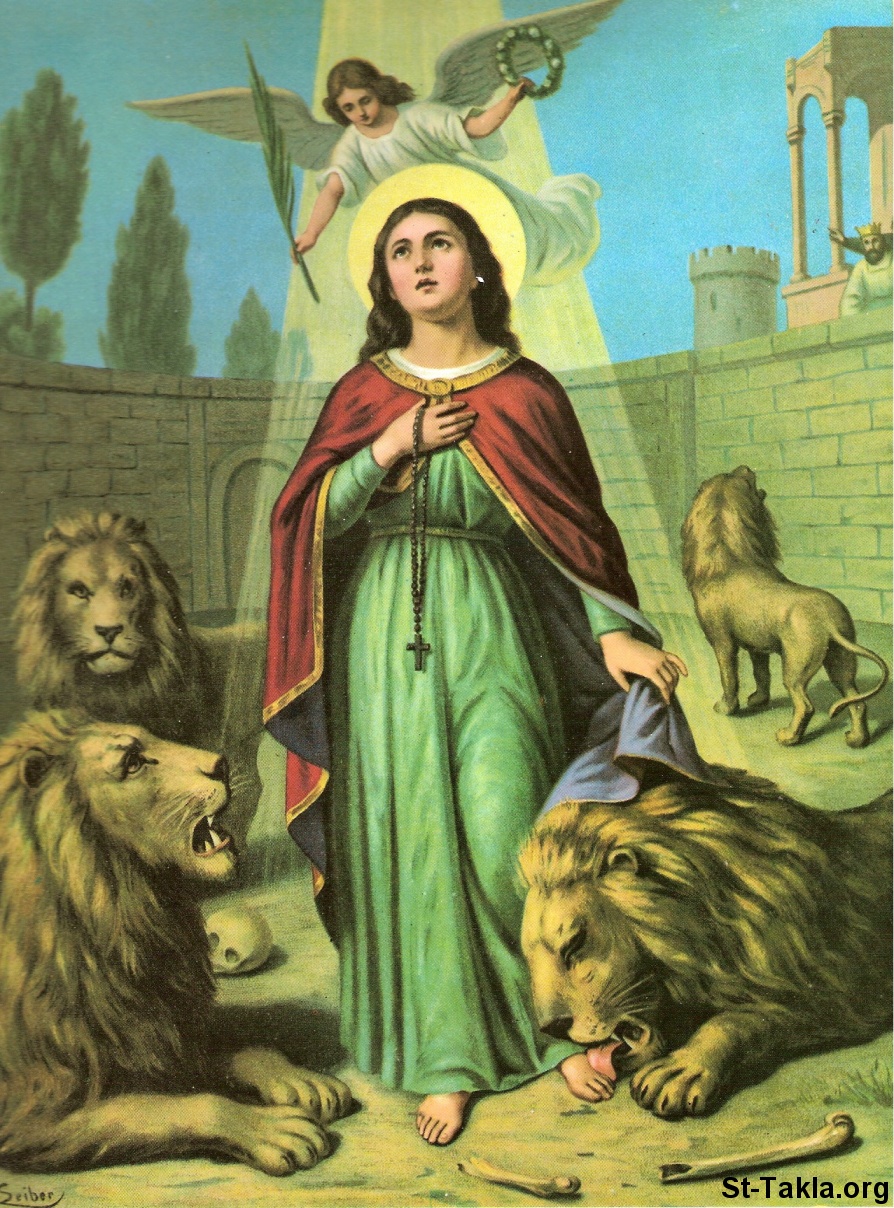 Thecla was a beautiful young pagan noblewoman who lived in the first century. She was from the city of Iconium, in Turkey. She read many philosophy books, yet nothing satisfied her desire to know about her Creator. When St. Paul the apostle came to preach the Gospel of Jesus in Iconium, Thecla's prayer to know the one, true God was answered. From St. Paul she also learned that a young woman can become the bride of Christ if she gives up marriage. By this time, Thecla desired nothing else than to give herself entirely to God.
 Thecla's pagan parents tried their best to make her give up her Christian faith, but she would not. Her fiancé, Thamyris, begged her not to break their engagement. However, Thecla had made up her mind. She wanted to be Christ's bride, not his. At last, in great anger, Thamyris accused her to the judge. When she still refused to give up her love for Jesus, she was ordered to be burned to death. The beautiful young woman bravely prepared to die. However, it is said that no sooner had the fire been lit than a storm from heaven put it out. Later, she was condemned to be eaten by lions. Once again, however, God saved Thecla's life. Instead of clawing her, the fierce beasts walked gently up to her, lay down at her side, and licked her feet, like pet kittens. At last, in fear, the judge set Thecla free. She went to live in a cave where she spent the rest of her long life. She prayed and taught the people who came to visit her about the Lord Jesus.
Wednesday, September 14, 2011
Triumph of the Cross - Poll Results
Today we celebrate our gratitude and love for Jesus through our respect for the cross. The cross was once the greatest symbol of shame. Criminals who died by the sword were spared the "branding" of crucifixion. Jesus chose to do the most for us to obtain our salvation. He took on the suffering of the cross. With that suffering came the shame.
The cross has become the most sacred Christian symbol. When the cross has the image of the suffering Christ on it, that cross is called a crucifix. The crucifix on our bedroom wall and the crucifix or cross around our neck are important. They remind us that Jesus paid a price for us.
For centuries relics of the true cross have been cherished by devout Christians. It is believed that Emperor Heraclius recovered pieces of wood from the cross of Jesus in 629. He and his group of pilgrims honored the relics and invited all the people in the area to join them. Even before that time, Christians honored and loved the symbol of the cross.
The word "cross" can also mean the sufferings that come our way. When we accept them lovingly and with patience as Jesus did his cross, we become "cross-bearers" like Jesus.

Due to the even results of the poll, St. Cecelia's Press will make no change to the subscription process at the present time. Thank you for voting.
Monday, August 29, 2011
Beheading of St. John the Baptist
Here is the story of St. John the Baptist from http://catholiclane.com/the-beheading-of-st-john-the-baptist/:
The tetrarch Herod Antipas having, in defiance of all laws divine and human, married Herodias, the wife of his brother Philip, who was yet living, St. John the Baptist boldly reprehended the tetrarch and his accomplice for so scandalous an incest and adultery, and Herod, urged on by lust and anger, cast the Saint into prison. About a year after St. John had been made a prisoner, Herod gave a splendid entertainment to the nobility of Galilee.
This strange request startled the tyrant himself; he assented, however, and sent a soldier of his guard to behead the Saint in prison, with an order to bring his head in a charger and present it to Salome, who delivered it to her mother.

St. John the Baptist was called by God to be the forerunner of His divine Son. In order to preserve his innocence spotless, and to improve the extraordinary graces which he had received, he was directed by the Holy Ghost to lead an austere and contemplative life in the wilderness, in the continual exercises of devout prayer and penance, from his infancy till he was thirty years of age.
At this age the faithful minister began to discharge his mission. Clothed with the weeds of penance, be announced to all men the obligation they lay under of washing away their iniquities with the tears of sincere compunction; and proclaimed the Messias, Who was then coming to make His appearance among them. He was received by the people as the true herald of the Most High God, and his voice was, as it were, a trumpet sounding from heaven to summon all men to avert the divine judgments, and to prepare themselves to reap the benefit of Vie mercy that was offered them.
Salome, a daughter of Herodias by her lawful husband, pleased Herod by her dancing, insomuch that he promised her to grant whatever she asked. On this, Salome consulted with her mother what to ask. Herodias instructed her daughter to demand the death of John the Baptist, and persuaded the young damsel to make it part of her petition that the head of the prisoner should be forthwith brought to her in a dish.
This strange request startled the tyrant himself; he assented, however, and sent a soldier of his guard to behead the Saint in prison, with an order to bring his head in a charger and present it to Salome, who delivered it to her mother.

Thus died the great forerunner of our blessed Saviour, about two years and three months after his entrance upon his public ministry, about a year before the death of our blessed Redeemer.
Thursday, August 4, 2011
Feast of Today
 Happy Feast of Saint John-Marie Vianney, the Cure of Ars and Patron of Priests!
Through the intercession of St. John Marie Vianney, we pray that all priests everywhere be comforted in the Love of Christ and vigilant in their apostolate of serving us, the servants of God.
Sunday, July 17, 2011
Pope St. Leo IV
St. Leo lived in the ninth century. He was a Roman by birth and spent his life in that city. Leo was educated in the Benedictine monastery near St. Peter's Basilica. He was ordained a priest and performed his ministry at St. John Lateran's, a large, famous basilica. Leo was well-known and loved by two popes, Gregory IV who died in 844, and Sergius II who died in 847. The death of Pope Sergius II was to have an immediate effect on Leo. Rumors of a barbarian invasion of Saracens had Romans terrified. They did not want to be left without a pope. Neither did the cardinals. They quickly elected the successor to Sergius II. He is known to history as Leo IV.
As pope, Leo had the city walls repaired. The walls had been damaged the previous year by a Saracen attack. He beautified churches and brought many relics to Rome. He started a renewal program for the clergy. In fact, in 853 he called a synod for all Roman priests. He passed forty-two rules which helped priests live more fervent, prayerful and joy-filled lives.
A few bishops caused Leo great suffering because of their lives. They confronted the pope openly and would not change their ways. No matter how much Pope Leo was insulted, he remained just, patient and humble. He never let his troubles get the best of him. Leo kept giving his time and energy for Jesus and his Church. He loved the beautiful prayers of the liturgy and encouraged liturgical chant and music.
People loved St. Leo. Even during his lifetime, he was considered a miracle worker. It is said that he was responsible for stopping the terrible fire in the English quarter of Rome. Pope Leo IV continued serving the Church with cheerfulness right up to the end of his life. He died on July 17, 855.
As pope, Leo had the city walls repaired. The walls had been damaged the previous year by a Saracen attack. He beautified churches and brought many relics to Rome. He started a renewal program for the clergy. In fact, in 853 he called a synod for all Roman priests. He passed forty-two rules which helped priests live more fervent, prayerful and joy-filled lives.
A few bishops caused Leo great suffering because of their lives. They confronted the pope openly and would not change their ways. No matter how much Pope Leo was insulted, he remained just, patient and humble. He never let his troubles get the best of him. Leo kept giving his time and energy for Jesus and his Church. He loved the beautiful prayers of the liturgy and encouraged liturgical chant and music.
People loved St. Leo. Even during his lifetime, he was considered a miracle worker. It is said that he was responsible for stopping the terrible fire in the English quarter of Rome. Pope Leo IV continued serving the Church with cheerfulness right up to the end of his life. He died on July 17, 855.
Friday, July 1, 2011
Saint of the Day: Bl. Junipero Serra
Junipero Serra was born in Petra, Spain, on November 24, 1713. The boy became a student at the Franciscan school in Palma, twenty-five miles away. He joined the Franciscan order on September 14, 1730, a few months before his seventeenth birthday. During the novitiate, Junipero read a biography of Franciscan saints. The saint whose life captivated him most was St. Francis Solano, who had lived from 1549 until 1610. This missionary priest to South America had just been declared a saint in 1726 by Pope Benedict XIII. The young novice decided that, if it was God's will, he too would be a missionary.
Junipero was ordained a priest in 1736. He became a professor of philosophy. After he had been in the order twenty years, he was given a wonderful opportunity. Franciscan friars were asked to volunteer for the mission territories called "New Spain" (Mexico and California). Junipero and his close friend, Friar Francisco Palou, joined the missionary band at Cadiz, Spain, a seaport city. From there they sailed the Atlantic Ocean to Vera Cruz, Mexico. They landed on December 6, 1749. Junipero and another friar walked the next part of the journey from Vera Cruz to Mexico City, a distance of 240 miles. They began on December 15, 1749, and arrived on January 1, 1750. From Mexico City, Junipero and Friar Francisco Palou were sent to work among the Pame Indians at the Franciscan Mission of the Sierra Gorda.
 Several of the friars were then assigned to missions in Lower California. Junipero, Francisco and a handful of other Franciscans were asked to bring the Gospel to the native peoples in Upper California. Junipero started Mission San Diego on July 16, 1769, when he was fifty-six years old. The mission was an open invitation to his beloved people to come and meet Jesus. Gradually, they trusted the friars. Some people were baptized and began to live the Christian faith. Father Serra and the friars loved and protected their people. The golden chain of new missions grew: Mission San Carlos in Monterey on June 1, 1770; Mission San Antonio de Padua on July 14, 1771; Mission San Gabriel Archangel, September 8, 1771; Mission San Luis Obispo, September 1, 1772; Mission San Francisco de Asis, October 9, 1776; Mission San Juan Capistrano, November 1, 1776; Mission Santa Clara de Asis, January 12, 1777; Mission San Buenaventura, March 31, 1782. Eventually, six thousand native peoples were baptized.
Blessed Junipero made his final tour of the missions in Upper California from the last part of 1783 until July of 1784. He died peacefully at Mission San Carlos on August 28, 1784, and is buried there. In 1988, Pope John Paul II declared Father Junipero Serra "blessed."
Junipero was ordained a priest in 1736. He became a professor of philosophy. After he had been in the order twenty years, he was given a wonderful opportunity. Franciscan friars were asked to volunteer for the mission territories called "New Spain" (Mexico and California). Junipero and his close friend, Friar Francisco Palou, joined the missionary band at Cadiz, Spain, a seaport city. From there they sailed the Atlantic Ocean to Vera Cruz, Mexico. They landed on December 6, 1749. Junipero and another friar walked the next part of the journey from Vera Cruz to Mexico City, a distance of 240 miles. They began on December 15, 1749, and arrived on January 1, 1750. From Mexico City, Junipero and Friar Francisco Palou were sent to work among the Pame Indians at the Franciscan Mission of the Sierra Gorda.
 Several of the friars were then assigned to missions in Lower California. Junipero, Francisco and a handful of other Franciscans were asked to bring the Gospel to the native peoples in Upper California. Junipero started Mission San Diego on July 16, 1769, when he was fifty-six years old. The mission was an open invitation to his beloved people to come and meet Jesus. Gradually, they trusted the friars. Some people were baptized and began to live the Christian faith. Father Serra and the friars loved and protected their people. The golden chain of new missions grew: Mission San Carlos in Monterey on June 1, 1770; Mission San Antonio de Padua on July 14, 1771; Mission San Gabriel Archangel, September 8, 1771; Mission San Luis Obispo, September 1, 1772; Mission San Francisco de Asis, October 9, 1776; Mission San Juan Capistrano, November 1, 1776; Mission Santa Clara de Asis, January 12, 1777; Mission San Buenaventura, March 31, 1782. Eventually, six thousand native peoples were baptized.
 Blessed Junipero made his final tour of the missions in Upper California from the last part of 1783 until July of 1784. He died peacefully at Mission San Carlos on August 28, 1784, and is buried there. In 1988, Pope John Paul II declared Father Junipero Serra "blessed."
Thursday, June 30, 2011
The First Martyrs of Rome
Today is the feast day of the first martyrs of Rome. It is the feast day of Christians such as Justin in our story, Diana and the Martyrs of Rome.
Since this is a special occasion, we will post Part IV ahead of schedule for you to read! In addition, there will be a page devoted to this story located below the blog title. (Click here!)

Diana and the Martyrs of Rome part IV
Despite the danger, Diana moved about with her father to try to rebuild their stock and home. Calixtus sent Justin to Diana, as Cosmos had very few slaves. The slave protected her from the madness of the city. They carried salvage from place to place, trying to find items that they could still use in the wreckage of their property.
One day, as they passed the Roman Colonnade where Nero could be seen at a distance during imperial audiences, they saw a great crowd of raging people. Justin and Diana tried to get around and out of the crowd, but as a great mass, the people carried the two along with them, closer to the Royal Balcony. The people were yelling and screaming mostly threats in their desperation.
Justin and Diana could see Nero step out onto the balcony overlooking the colonnade. His arms stretched high and suddenly the crowd was silent. They could feel each others’ anticipation of the words of the emperor. As a stunned wild beast, all was still, so Nero’s voice was heard clearly.
He said, “Citizens of Rome! I hear ye. Tirelessly, I have worked to discover the identity of our great enemies. The great enemies that have put fire to the city of Rome. As I have promised to discover the people who are responsible, I promise to bring them to justice. We will rebuild Rome! We will make it better than before! And as a testament of this, I shall kill everyone responsible for this catastrophe; I shall kill every member of the sect of Christians!”
Cries and cheers resounded in the colonnade and the chaos resumed. This time the people were more violent, as each had a different destination. Diana and Justin were beaten and bruised in the fight, finding it difficult merely to stand. Eventually, Justin grasped Diana’s hand and cut through the crowd. He reached a narrow alley and pulled Diana into it. They stayed there until the crowd finally dispersed.
Meanwhile, Diana said, “I don’t understand. How can it be true?”
“It isn’t true,” Justin replied, “Someone who hates Christians must have convinced the emperor. Nero is weak and easily swayed. Come now, I must get you to my master’s house; it will be the safest place.”
But, before they could reach Calixtus’ home, a second crowd blocked their way. An angry mob, just like the first, crowded the street with fierce yells of hatred. Involuntarily, Diana and Justin were forced to the fray. Diana could not distinguish what was going on, but Justin saw through the mass of people and suddenly grew white. The people were armed with stones and stood over a Christian slave.
As the men shouted insults, the slave replied, “In the name of God and Rome I promise you that the allegation is false! The Christians did not start the deadly fire.”
“Then who did?” asked one man.
The slave responded, “I saw who started the fire. It was the Praetorian Guard.” He paused to moan as the first stone hit him on his back. “It was Nero himself who ordered that Rome be burned to the ground. The Christians were blamed to satisfy the blood cry of the Romans.”
More stones were flung at him and the people condemned him for accusing the emperor. The Christian muttered prayers to God as violent curses resounded around him. Justin grabbed Diana’s hand again and forced their way out of the crowd. But, before they were out of earshot, they heard the sound of the fateful stone that silenced the Christian and brought him into the Eternal Kingdom.
The rest of the journey to Calixtus’ house was eerily quiet. When they arrived, Diana’s eyes were flowing with tears. She sat down upon the cold steps of the ruined courtyard, dirty with dust and sweat. She said, “How can you stand it, Justin? Your people are being murdered in the streets.”
“It is as it was expected,” Justin replied. He sat down beside her and offered her wine to calm her. “Christ said, ‘Blessed are they who are persecuted for My sake.’ He told us that this day would come.”
“But, you too will be killed,” she cried. “Surely a belief is not worth your death.”
Justin smiled down at her and said, “It was worth My Lord’s life to gain salvation for all. Surely it is worth my death for Him. Besides, if a belief is not worth dying for, why trust in it?”
Diana refused to give up. She grasped his arm and wept, “You must give it up, Justin! I can’t see you die.”
But, he smiled even more and simply shook his head. Diana looked down at the floor. They had been seated for a little while when she suddenly brushed away her tears, looked up at him, and said, “Then I must come with you. If there is so much faith and love in God, then I must have a share in it.”
To be continued…
Subscribe to:
Posts (Atom)